
In short
For a small studio, four core features matter: online booking with a class schedule, member management, automatic payments by SEPA Direct Debit and simple communication with members. Easy handling, a transparent price and a contract you can cancel monthly matter more than a long feature list.
You’re looking for gym software and everywhere you find glossy promises, endless feature lists and prices that only come out after a sales call. That’s frustrating, especially if you run a small fitness, Pilates or yoga studio and have neither the time nor the budget for expensive mistakes.
This guide turns things around. Instead of yet another ranking of providers, you get a clear decision framework: which features you really need, what good gym management software honestly costs and which contract pitfalls to look out for before you sign. We build software for small studios ourselves, so we know the stumbling blocks first-hand.
What gym software should do, and what you really need
Good gym software runs in the background and takes admin off your plate. You stay the head of your studio, the software does the paperwork. It should give you time back, not saddle you with new complexity.
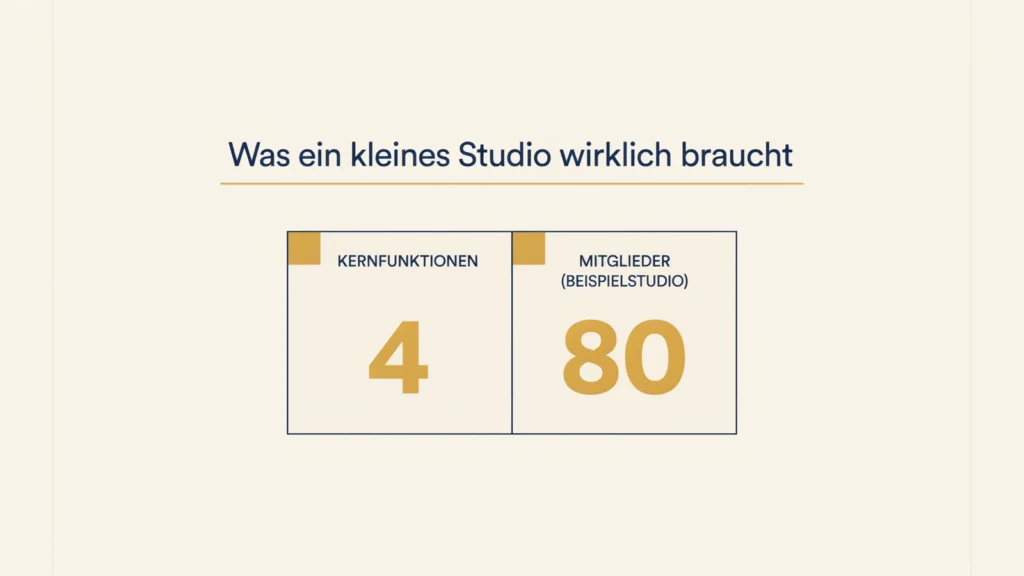
For a small studio, four core features matter: online booking with a class schedule, member management, automatic payments by SEPA Direct Debit and simple communication with your members. Everything else is a bonus.
Many systems show off with access control, a complex training plan editor and marketing automation. That sounds impressive, but you pay for every feature, including the ones you never touch. Nice-to-haves quickly become dead weight that makes the software harder to find your way around.
Systems built for chains, with reporting overkill, solve problems you don’t have. You don’t need cross-location revenue analysis for your single studio with 80 members. You need a system that lets a client book a class at eleven at night without you having to step in.
So the basic rule is: easy handling beats any long feature list. A tool you can use blindfolded after a week helps you more than an all-rounder that needs training. By the time you are opening your studio at the latest, you’ll notice how valuable a system is that simply works.
Which features do you need as a small fitness, Pilates or yoga studio?
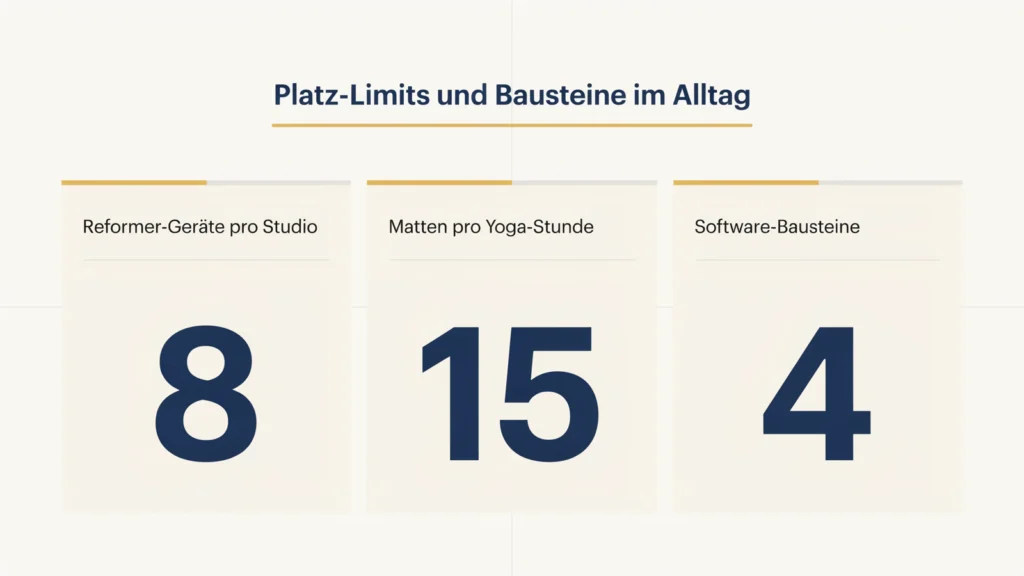
In short: online booking with a waitlist, clean member management, automatic payments and a self-service app for your members. These four building blocks cover the day-to-day of a small studio completely.
Booking and class schedule are at the centre. Your classes have limited spots: a full Pilates reformer studio might have eight machines, a yoga class 15 mats. The software has to count spots, run a waitlist and, for EMS or reformer, assign individual machines to the right sessions.
Member management reflects how you actually charge: ongoing contracts, 10-class passes, trial classes and pauses for holidays or injuries. If you juggle that by hand, sooner or later you lose track of outstanding payments.
Payments work best when they run automatically. A system that collects monthly by SEPA Direct Debit saves you chasing people. The SEPA Direct Debit scheme is the European standard for recurring collections, which is exactly right for membership fees. What matters: you want to see at any time who has paid and where a returned debit is stuck.
The member app or a self-service portal takes the evening work off your hands. Your client books and cancels herself and sees her pass and her schedule. You no longer have to answer every request on WhatsApp. This is also where good software and marketing work together: if you make booking easy, it’s easier to win more members.
For EMS, reformer and small-group concepts, also look for fixed time slots per instructor, equipment limits and the option to offer individual sessions instead of open classes. A pure class booking system quickly hits its limits here.
What does gym software really cost?

Realistically, small studios pay a low to mid double-digit amount per month for solid software, depending on the pricing model and number of members. The catch: many providers don’t state that price openly anywhere.
There are three typical pricing models:
- Monthly base fee: a fixed amount regardless of the number of members. Predictable and fair for small studios.
- Per member: costs grow with your studio, which gets expensive if you grow fast.
- Percentage of payments: sounds harmless, but takes a share of your revenue with every collection.
It’s striking that many providers show no price on their website. Instead there’s a “Book a demo” button and a sales call. For you, that means investing time before you even know whether you can afford it, and often facing a trained sales team.
On top of that come hidden extra costs that tend to be missing from the first quote: setup and onboarding fees, paid training, the member app as an extra and transaction fees per payment. In the end you pay twice the advertised entry price.
To make quotes comparable, always calculate the total price for a year, including setup, app and transaction costs at your real number of members. Only then do you see what you’re really in for.
That’s exactly why price transparency becomes a selection criterion: a provider that puts its price openly on its website has nothing to hide. Open price = trust. If a provider only comes out with it during a call, there’s usually a reason.
Is free gym software a good idea?

Free gym software exists, as freeware or a free plan, but it quickly hits clear limits on payments, automation and data protection. Fine for the very beginning, rarely sustainable as a long-term solution.
Free plans often cover only the basics: a simple calendar, a handful of members, manual entries. As soon as you want to collect fees automatically, run waitlists or store data in line with GDPR, the provider asks you to move to a paid plan, and that isn’t always cheap.
The supposedly free combination of Excel, WhatsApp and bank transfer is the most expensive route of all. It costs you no money, but plenty of time: you copy out bookings, check incoming payments by hand and answer every cancellation yourself. Those hours are missing for classes and clients, and at some point a payment slips through.
Free also usually ends exactly where it matters: at secure payment processing, automation and proper data protection. Member data and health data in particular are not something you want to store in a tool that only half-heartedly complies with GDPR.
A cheap entry point makes sense if you’re just starting and testing with fewer than ten members. As soon as real money is flowing and bookings pile up, you’re better off going straight for a proper solution at a fair price. It saves you a painful migration six months later.
The most common pitfalls when choosing

The biggest stumbling blocks are long contract terms, blocked data export, an expensive migration and support that goes quiet once you’ve signed. Check these four points and you’ll save yourself a lot of trouble.
Long contract terms with automatic renewal often tie you in for one or two years, and quietly renew for further months if you miss the notice period. Reformed German consumer contract law has defused such traps: under the rules on contract terms in the German Civil Code (BGB), excessively long commitments and automatic renewals are only permitted to a limited extent. Even so, they keep turning up in software contracts, so read the small print.
Data lock-in is treacherous. Some providers make it expensive or impossible to export your member, booking and payment data. Without free export you’re stuck, even if you’ve long wanted to switch. Ask before you sign: can I export my data myself, at any time and free of charge?
Migrating from your old system often decides whether a switch works at all. If nobody helps you transfer your existing data cleanly, you’ll stay with the old provider out of sheer convenience, even if it’s more expensive or worse.
Support that disappears after signing is a classic. In the sales call you’re king, afterwards you’re stuck on hold. A look at real reviews quickly shows you how a provider responds day to day.
And finally: investor-driven platforms change their priorities. When pressure to grow and return expectations rule, prices go up and features move into more expensive plans. Being close to small studio owners then counts for less than the next funding round.
How to find the right solution: your checklist
You find the right gym software by first clarifying what you need and then checking every provider with the same hard questions. That finally makes different offers comparable.
Step 1 – clarify what you need:
- What type of studio are you? Fitness, Pilates, yoga, EMS, reformer: each concept has its own requirements.
- How many members do you have today, and in a year?
- What does your class structure look like? Open classes, fixed small groups, individual sessions or a mix?
Step 2 – check providers: Ask every provider the same five questions:
| Question to check | Why it matters |
|---|---|
| Is the price published on the website? | Transparency instead of sales pressure |
| Can the contract be cancelled monthly? | No commitment without a trial period |
| Can I export my data freely? | Protection against lock-in |
| Is migration from the old system included? | Switching without extra costs |
| Where are the servers? | GDPR in the DACH region |
GDPR and EU servers are a must for studios in the DACH region, not a bonus. You store member data, payment data and sometimes health data, and these belong on European servers and under the GDPR requirements. A provider hosting outside the EU puts you in legally uncertain waters.
Use the trial properly: Don’t just watch the shiny demo, use the system yourself. Create a test class, book as a member, set up a payment. Only then will you notice whether it holds up in everyday use.
And read real reviews. They are an honest mirror of what support and everyday usability really look like. Not as the only criterion, but as a reality check next to the marketing promises.
Why StudioHero is a fair choice for small studios
StudioHero is designed for exactly what small fitness, Pilates and yoga studios need: clear prices, no lock-in and an easy switch. No reporting overkill, no sales pitch.
The price is on the website. You don’t have to sit through a sales call or book a demo just to find out what it costs. What you see is what you pay, openly and easy to check.
The contract can be cancelled monthly instead of chaining you to an annual contract. So there’s no fixed term putting you under pressure. If you stay, it’s because the software fits, not because a contract holds you.
Migration from your old system is free. We help you transfer your existing data cleanly, and because you can export your data freely at any time, it’s just as easy to leave again. No lock-in, no hostage situation.
StudioHero is built for small studios (fitness, Pilates, yoga, EMS and reformer), not for chains with 40 locations. Limited spots, waitlists, equipment assignment, 10-class passes and trial classes are handled the way you actually use them.
And the software comes from Europe, runs GDPR-compliant on EU servers and is developed close to what small studio owners ask for. No investor pressure that turns prices up tomorrow, but a solution that’s on your side.
Already using a system and thinking about switching? The comparisons with Eversports, Magicline, Fitogram, Mindbody, bsport, Momoyoga, Yolawo, Trainin and Zenamu will help: prices, contract terms and fees, as far as the providers publish them.
Which features matter for your concept is shown on the pages for yoga studios, barre studios, EMS studios and small-group training.
When StudioHero is not the right choice
To be honest: StudioHero isn’t right for everyone. Large chains and studios with a heavy hardware focus are better off with other systems, and we’d rather say so openly than sell you something that doesn’t fit.
If you run a large chain with many locations and need cross-location reporting, complex role management and central control of dozens of branches, specialised enterprise systems are the better choice. A lean solution isn’t made for that.
Studios with a heavy focus on hardware and access control (turnstiles, chip cards, 24/7 access without staff) also need tightly integrated hardware that goes beyond pure management software.
A lean solution doesn’t cover every niche, and that’s not a weakness but a deliberate decision. Trying to be everything for everyone quickly makes software too complicated and too expensive for small studios.
This honesty helps your decision more than any marketing promise. A provider that tells you when it doesn’t fit also means it when it says it does.
Frequently asked questions
How much does gym software cost per month?
Small studios usually pay a low to mid double-digit amount per month, depending on the number of members and the pricing model. Watch out for hidden setup, transaction and app costs that can quickly double the advertised entry price. StudioHero shows its price openly on the website, no sales call needed.
Is there free software for gyms?
Yes, there is freeware and there are free plans, but they quickly hit limits on automatic payments, automation and GDPR. The combination of Excel, WhatsApp and bank transfer ends up costing you more time than affordable software costs per month. Fine for a test start, rarely sensible as a long-term solution.
Which features does software for a small studio need?
You need online booking with a waitlist, clean member management, automatic payments by SEPA and a self-service app for your members. Access control and complex reporting are usually unnecessary for small studios and only make the software harder to use.
How hard is it to switch to different gym software?
That depends entirely on data export. If the old provider blocks your data or charges for it, switching becomes a hurdle. That’s called lock-in. Free data export and a free migration, as StudioHero offers, make switching straightforward.
Should I choose software with a long contract term?
No, for small studios contracts you can cancel monthly are the safer choice. German consumer contract law has restricted long commitments and automatic renewals, but they still turn up. Don’t commit without a real trial period. Flexibility protects you.
Is the software GDPR-compliant if I store member data?
You have to check that actively. You store member data, payment data and sometimes health data, and these belong on EU servers and under GDPR. Prefer providers with European hosting and documented GDPR compliance, especially for sensitive data.

Written by
Studio software with no small print
Booking, members and payments for your studio. Fixed price, no commission per booking.
From 39 € a month · no credit card · cancel monthly · free migration